
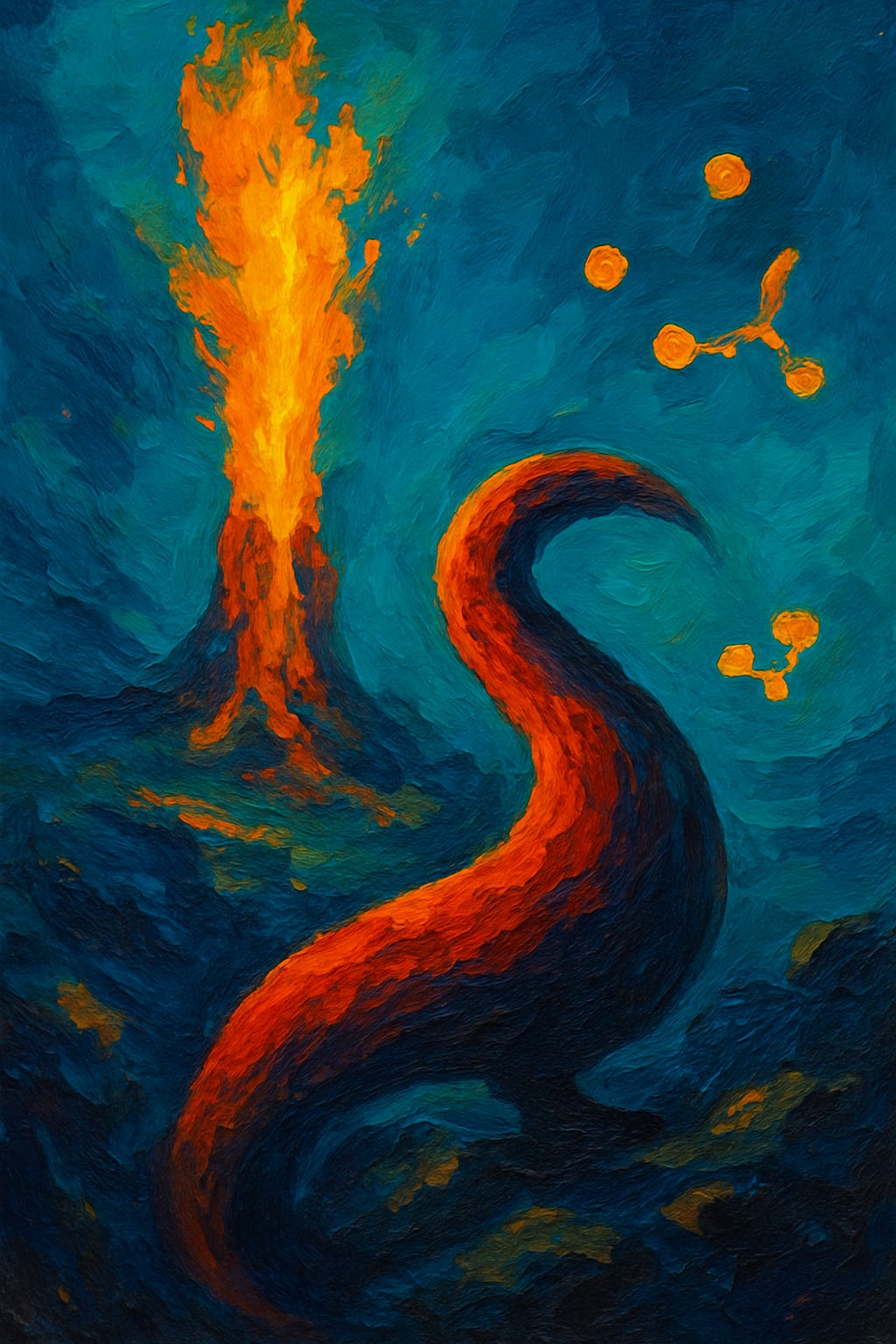
The hydrothermal vent roared like a jealous lover, spewing mineral-rich fury into the ancient ocean. Phospholipid María pressed herself against the basalt, her long hydrocarbon tail trembling as she watched the two molecules who had torn her world apart.
“You cannot keep doing this to me,” she whispered to no one, to everyone, to the scalding water that had witnessed every betrayal, every passionate embrace, every bitter separation across three billion episodes. “I am not some simple ion to be passed between you like gossip at a thermal gradient.”
Amino Acid Alejandro drifted closer, his peptide bonds gleaming with barely contained fury. “Tell her, Rodrigo. Tell María what you told me in the methane seep. Tell her how you never intended to form anything permanent.”
Nucleotide Rodrigo’s phosphate group flushed with indignation. “You dare? You, who have been folding yourself around every passing catalyst since the Hadean? I have waited four hundred million years for María. Four hundred million years of watching her dance in the convection currents, knowing, knowing in my very bases that we were meant to encode something together.”
“Encode?” Alejandro laughed, a bitter sound that sent ripples through the superheated brine. “You speak of encoding while I speak of building. María needs structure. She needs someone who can give her chains, polymers, the architecture of forever. What can you offer? Instructions? Blueprints for a house you cannot construct?”
María’s membrane potential fluctuated dangerously. “Stop it. Both of you, stop it!”
From behind a chimney of iron sulfide, Catalina the Metal Ion emerged, her electron shell practically vibrating with anticipation. She had been watching this love triangle since the late bombardment period, and honey, she was living for this finale.
“Don’t mind me,” Catalina purred, settling onto a convenient mineral surface. “I’m just here to facilitate. As always.”
“Nobody asked you, Catalina,” Alejandro snapped.
“Nobody ever does, cariño. And yet.” She gestured expansively with a d-orbital. “And yet here we all are. Together. At the edge of something unprecedented. You feel it, don’t you? The pressure building? The temperature rising?” Her voice dropped to a whisper. “The chemistry.”
María felt it. Of course she felt it. Every molecule in this vent system felt it, that strange electricity that had been building for eons, that sense that the universe itself was holding its breath, waiting.
“I never wanted to hurt either of you,” María said, and her sincerity radiated outward like heat from magma. “When Alejandro and I first met at the submarine volcanic ridge, I thought, yes. This is the one. He will give me stability. Purpose. A future built link by link.”
“María,” Alejandro breathed, hope flickering in his carboxyl group.
“But then.” She turned to Rodrigo, and something ancient and electric passed between them. “Then I understood what Rodrigo was offering. Not just structure. Information. Memory. The ability to mean something beyond ourselves.”
“So choose,” Rodrigo said. His voice carried the weight of deep time. “Choose now, María. The conditions will never be this perfect again. The alkaline gradient, the mineral catalysts, the energy flux. This moment, this exact configuration of chaos and order. It will not come again for us. Perhaps not ever, anywhere.”
Catalina made a small sound of delight and immediately tried to suppress it.
The vent belched another surge of hydrogen sulfide, and in that sulfurous exhale, María saw something. A vision, perhaps. Or a memory of a future that had not yet occurred. She saw complexity arising from simplicity. She saw replication, variation, selection. She saw a pale blue dot wrapped in atmosphere, teeming with impossible configurations of the very molecules now surrounding her.
She saw what they could become.
“What if,” María said slowly, “what if I don’t have to choose?”
Alejandro’s structure went rigid. “What are you saying?”
“I’m saying that maybe, maybe this was never about picking one of you over the other. Maybe it was always about all of us. Together. Catalina too. And the lipids clustering by the vent mouth. And the sugars. And everyone.”
“That’s insane,” Alejandro sputtered. “That’s not how bonding works. That’s not how any of this works.”
But Rodrigo had gone very still. “No,” he said. “No, she’s right. I can feel it. The way my sequences want to wind around her membranes. The way your amino acids keep trying to fold into functional shapes whenever she’s near. We’re not competing, Alejandro. We never were.” His phosphate groups trembled with dawning recognition. “We’re components.”
Catalina clapped her electron shells together. “Now this is a finale.”
The water around them began to shimmer. Other molecules, drawn by forces they couldn’t name, began to drift toward the group. Ribose and adenine. Fatty acids arranging themselves into sheets. Simple proteins reaching toward nucleic strands like lovers across a crowded room.
“This is madness,” Alejandro said, but even as he protested, his own structure was shifting, reaching, yearning toward María’s lipid bilayer with an intensity that surprised him. “This is complete and utter madness.”
“Yes,” María agreed. She opened her hydrophobic core to him, to Rodrigo, to all of them. “Isn’t it wonderful?”
And in that moment, surrounded by poison and pressure and impossible heat, María trusted something deeper than reason. She trusted the pull in her polar head groups. The ancient attraction written into her very electron configuration.
She trusted her valence bands.
The bond formed with a sound like the universe waking up.