

The framework agreement was eleven pages long, and Dariush Tavakoli had read it forty-three times. He knew this because he kept a tally in the margin of the first page, a small hash mark each time he returned to the opening clause. It was a habit from law school in Lyon, back when he still believed that if you read a document enough times, every ambiguity would resolve itself into clarity. He was fifty-eight now and no longer believed that about documents or anything else.
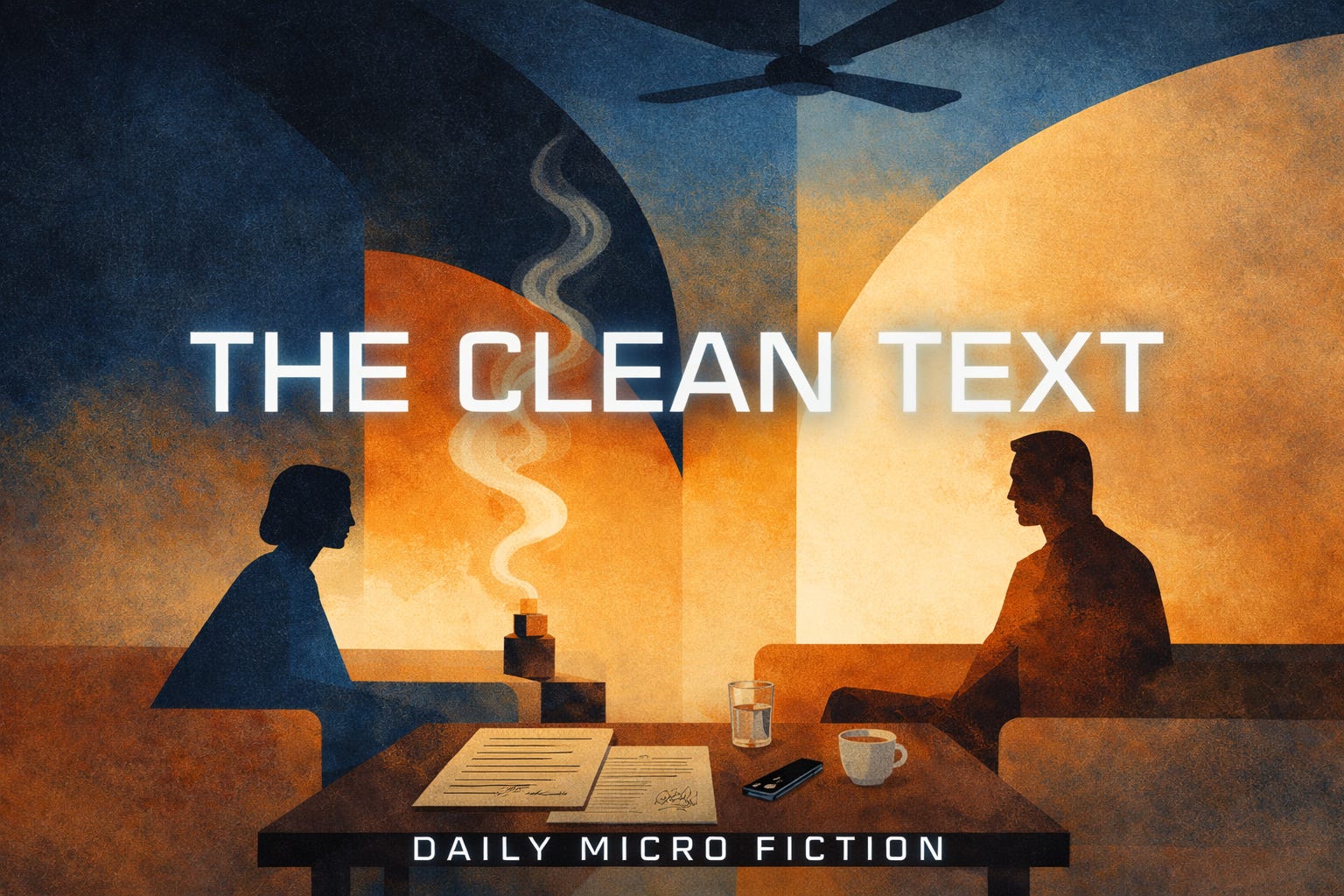
The sitting room smelled of frankincense. Someone on the hotel staff had lit a burner near the window, and the smoke curled in slow spirals toward the ceiling fan, which turned without urgency. Outside, the Gulf of Oman was doing whatever the Gulf of Oman did at eleven o’clock at night. Dariush did not look. He had spent three weeks in Muscat and had not once walked to the water.
On his phone, the message from Tehran sat like a stone at the bottom of a well.
Insert language on Section 7.3. Inspections must exclude all military sites not previously declared. Non-negotiable.
He knew what the clause would do. He had drafted enough poison pills in his career to recognize the taste. The Americans would read it, understand it for what it was, and the entire architecture of the agreement, three years of back-channel conversations, fourteen months of formal talks, this final week of grinding through sub-clauses until his eyes ached, would collapse. Tehran would blame Washington. Washington would blame Tehran. The newspapers would move on to the next crisis. And the centrifuges would keep spinning.
His brother Kaveh had been twenty-two when the missile hit the barracks outside Khorramshahr. That was 1982. Dariush had been fourteen, sitting in a classroom in Lyon conjugating French verbs, and he had not learned about it for six days because the phone lines were down and his mother’s letter traveled by way of Istanbul. He still remembered the verb he had been conjugating when the letter arrived. Partir. To leave.
He heard footsteps in the corridor. Measured, unhurried. He knew them.
Catherine Hale entered without knocking, which was itself a kind of negotiation. She wore a dark blazer over a white blouse, no jewelry, her reading glasses pushed up on her head. She carried a leather folio and a cup of tea she had clearly made herself; the hotel’s tea service came on silver trays, and hers was in a paper cup.
“You’re still here,” she said.
“Where else would I be?”
She sat across from him. The table between them was low, carved from Omani rosewood, and it held the document, his phone face-down, and a glass of water he had not touched. Catherine set her tea beside his water.
“My people went to bed an hour ago,” she said. “Except for Dan, who is on the phone with the National Security Council. They want to add a sunset clause. Three years.”
“Three years is meaningless.”
“I told them that.” She sipped her tea. “They said they’d consider five.”
“Five is also meaningless, but it is meaningless in a way we could perhaps work with.”
She almost smiled. He saw it happen and then not happen, a flicker of warmth that she redirected into a careful study of the document’s cover page.
“Dariush.”
“Yes.”
“Did you get new instructions tonight?”
He looked at her. In the intelligence world she had come from, this question would have been an extraction technique. Here, in this room, he understood it as something simpler. She was asking because she could see it on his face. Three weeks across a table from someone and you learn to read them the way you read a text, marking every hesitation, every shift in register.
“I received guidance,” he said carefully.
“Guidance that changes things?”
He picked up his phone, turned it over, and set it back down without showing her the screen. The gesture was answer enough. Catherine’s jaw tightened. She looked at the window where the frankincense smoke was thinning.
“I spent eleven years at Langley,” she said quietly. “Eleven years reading cables about what your government was building and why. I left because I got tired of watching people describe problems they had no intention of solving.” She turned back to him. “I did not come to Muscat to watch it happen again.”
The ceiling fan turned. The frankincense had nearly burned out, its last thread of smoke barely visible.
Dariush opened his folio. Inside were two versions of page eight. One contained the clause Tehran had demanded, the language on Section 7.3 that would send Catherine’s team to the airport by morning. The other was the clean text, the version they had agreed on together, word by careful word, over nine days of negotiation.
He removed the clean text and slid it across the rosewood table.
Catherine looked at it. She looked at him. She did not ask what the other page said.
“This is what you are offering?”
“This is what I am offering.”
She opened her folio, produced a pen, and initialed the margin of page eight. Then she turned the document and held the pen out to him. He took it. The pen was heavy, American-made, government-issue. He initialed beside her mark.
“Catherine.”
“Yes.”
“No one can know that I had another version.”
She capped the pen. She placed it back inside her folio. She finished her tea and set the paper cup on the table beside his untouched water.
She said nothing, and then she left.
Dariush sat alone in the sitting room. He picked up the other page, the one with Tehran’s clause, and folded it once, then twice, then again until it was small enough to fit inside his breast pocket, where it would stay, close to his chest, for a very long time.