

Bill’s phone buzzed as he rolled through the first toll station on I-77. Forty-three cents. He tapped to confirm, and the follow-up prompt appeared before the charge had even settled: Would you like to round up to $1.00 and donate the difference to the Carolina Children’s Fund? A little heart icon pulsed beside it, red and plump as a valentine.
He tapped yes. Of course he tapped yes.
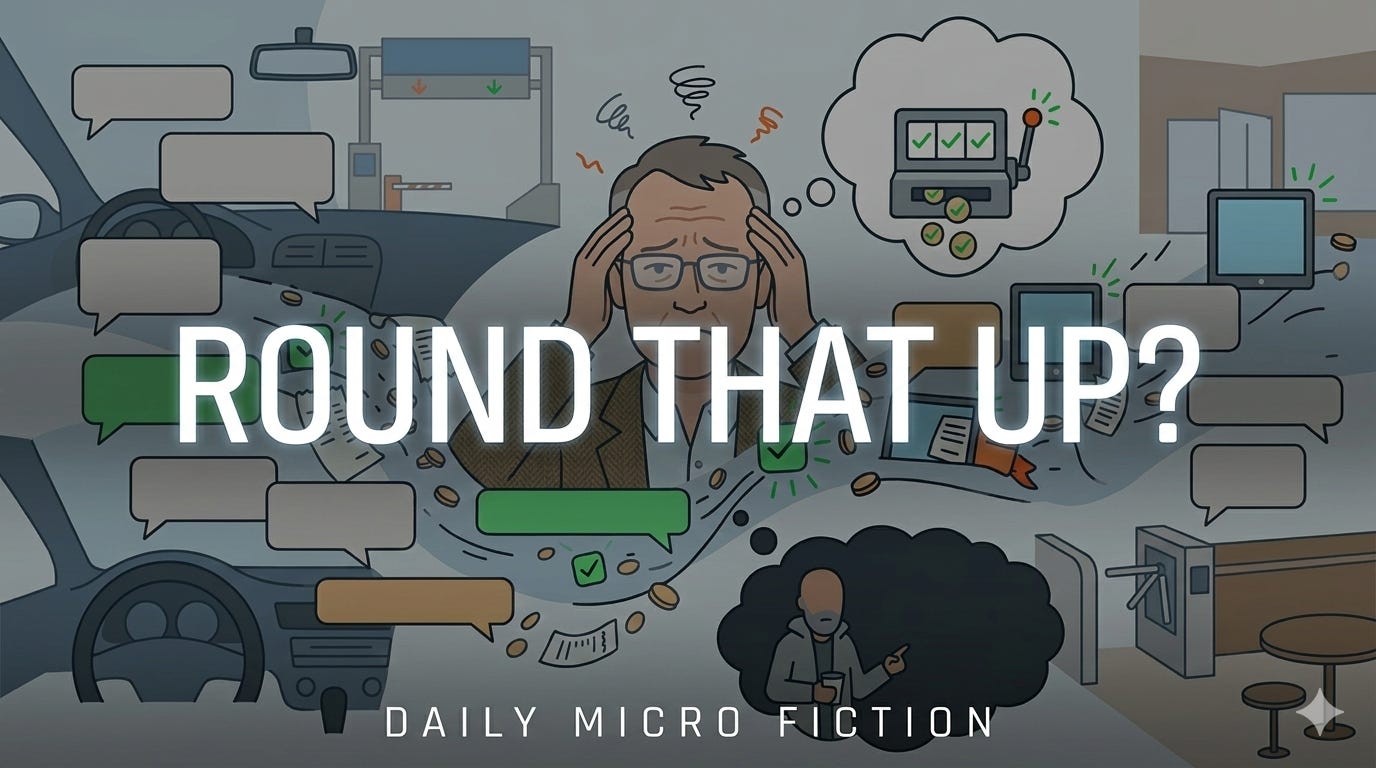
The second toll came six miles later. The third at the interchange. Each one trailed by that same pulsing heart, that same question, gentle as a hand on the shoulder that wouldn’t lift. Fifty-seven cents to charity. Twenty-two cents. Eleven. Bill had written a paper about this once, back when he still believed that the frictionlessness of digital payments represented unambiguous progress. “The Vanishing Threshold: How Micropayment Architecture Reshapes Consumer Sensitivity.” Forty-one citations. He’d been proud of it.
The parking garage wanted eighty cents to let him in. The concrete ramp descended into that particular yellow-gray light that all parking garages share, the light of places built to be passed through. He paid. He rounded up. The little heart pulsed.
A chime sounded as he crossed the threshold of the coffee shop, and his phone displayed the entry fee: thirty-five cents, automatically deducted from his digital wallet. A line of text beneath it read: Your visit helps us maintain a welcoming space for all. Beneath that, the heart.
“Yes,” he said aloud, to nobody, and tapped.
The shop smelled like roasted everything, dark and sweet, the kind of warmth that should have settled him. The line moved slowly. A woman ahead of him tilted her phone toward the pastry case and a price tag floated onto her screen, augmented and cheerful. When he reached the counter, he ordered a cortado, paid, rounded up, slid the phone back into his pocket. Then he turned to find a seat and the phone hummed against his thigh. The window table, the one catching a bar of morning sun and overlooking the old magnolia on Trade Street, carried a fifteen-cent premium. The corner table by the restroom was free.
He stood there with the cortado cooling against his fingers. Somewhere in the back of his skull, the part of him that had built a career mapping price signals pointed out that this was simply the market allocating scarce resources through revealed preference. Window seats were worth more. People had demonstrated willingness to pay. The price emerged. The charity prompt followed. Elegant. Rational. The logic was so clean it was like a proof that arrived at the wrong conclusion.
He tapped the window seat. He rounded up.
The magnolia was in early bloom, its white petals luminous against the bark like scraps of paper caught in a dark hedge. March light poured through the glass and pooled on the table, and for a few seconds the world outside the phone existed fully: the petals, the light, the bitter velvet of the cortado on his tongue. Then the phone vibrated. A surcharge for peak-hour seating. Then again. A content license fee for the jazz coming through the ceiling speakers. Then again. A two-cent infrastructure maintenance levy. Each one followed by the heart, the prompt, the question. The intervals between buzzes felt shorter each time, like a drip picking up speed.
His thumb moved to the green button before his eyes finished reading the amounts. He had written about this phenomenon too, in a paper that coined the phrase “ascending prosocial compliance.” The mechanism was simple: each round-up cost almost nothing, but declining one felt like peeling off a mask in public. So you kept tapping. You kept rounding. The green button became a reflex, like scratching an itch that someone else had placed on your skin.
Bill drained the cortado and stood. On his way to the door, the exit sensor logged his departure and a final notification swelled onto his screen: Thank you for visiting! You donated $4.12 to charity today through your round-ups. The heart was bigger this time, animated, bouncing like a dog greeting its owner.
Four dollars and twelve cents. His neck was tight. A muscle in his temple had been ticking for the last ten minutes and he’d only just noticed.
The man was sitting on an overturned milk crate just outside the door, a square of cardboard propped against his shins. Weathered hands, a coat with the collar turned up against the March chill even though it wasn’t that cold. He looked up as Bill came out.
“Hey. Spare anything?”
Bill reached into his jacket and pulled out a crumpled five. He held it out without slowing down.
The man took it, turned it over once like he was checking for something, then looked up. “Appreciate it. You want to round that up to ten?” He said it the way a cashier says “receipt?”: automatic, polite, already expecting the answer. “I take digital. Goes to Mecklenburg County Shelter Fund.”
Bill stopped walking. He turned around. The man’s face was patient, unsurprised, the face of someone who had asked this question enough times that it had worn smooth.
“No,” Bill said. The word came out harder than he meant it to.
The man tucked the five into his coat, slow and deliberate, and shook his head. “Pretty selfish, brother.”